Rise of regional security
Makkah Agreement is set to expand fairly soon, bringing into its fold many other countries in region, including Egypt, Qatar and others
Published September 03, 2026
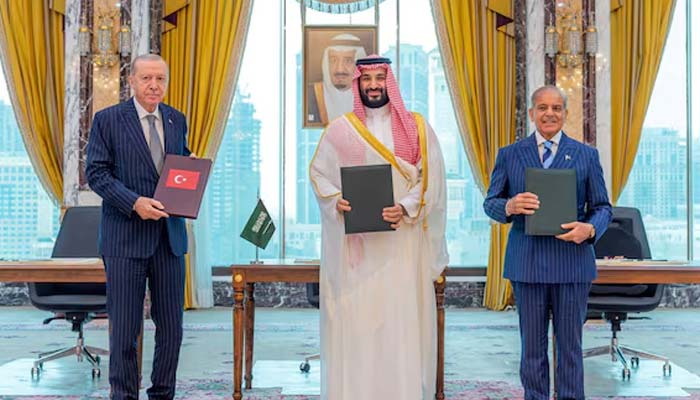
The Makkah Joint Defence Agreement between Pakistan, Saudi Arabia and Turkiye is significant not because Muslim countries have never attempted collective security before, which they have. Its importance lies in the three states coming together, the strategic moment at which they have done so, and their movement from longstanding bilateral defence relationships towards an institutionalised, regionally conceived and regionally owned collective-security framework.
Pakistan’s relationship with the wider Muslim region has always been multidimensional – ideological and civilisational, political, security-based, economic and also consistently people-based. From Saudi Arabia and the Gulf through Iran and Turkiye, extending towards the Levant and North Africa, and eastwards to Malaysia and Indonesia, Pakistan has accumulated relationships over decades that transcend conventional interstate diplomacy.
Millions of Pakistanis have lived and worked in the Gulf, contributing to these economies while their remittances became important to Pakistan. Alongside these human connections grew institutional ones: military training, exercises, security cooperation, defence sales and Pakistani personnel assisting friendly states in developing their capabilities. Saudi-Pakistan defence ties, in particular, go back decades. Pakistan-Turkiye defence cooperation has meanwhile expanded into exercises, platforms, technology and defence production.
The Makkah Agreement therefore represents continuity before it represents change. But it transforms that continuity into something strategically new. The immediate trajectory of Makkah begins with the extraordinary events of May and June 2025. Pakistan’s May confrontation with India demonstrated its capacity to respond militarily to a considerably larger adversary, combining conventional capability with technology, electronic warfare, air power and integrated command. Whatever competing narratives subsequently emerged, Pakistan came out of that confrontation with enhanced strategic confidence and renewed positive international attention.
Then Israel attacked Iran in June. Pakistan took a clear position: it condemned the attacks as violations of Iranian sovereignty and international law, supported Iran’s right of self-defence, but simultaneously pushed de-escalation and diplomacy. The diplomatic choreography was remarkable. On June 18, COAS-CDF Field Marshal Asim Munir met US President Donald Trump at an unprecedented White House luncheon where the escalating Iran-Israel confrontation was discussed. The COAS then travelled to Istanbul, where he and Foreign Minister Ishaq Dar met Turkish President Recep Tayyip Erdogan during the OIC gathering. Turkiye’s official account records Erdogan warning that Israel’s attacks on Iran created risks for both Turkiye and Pakistan as Iran’s neighbours, while advocating renewed US-Iran diplomacy. When the United States subsequently attacked Iranian nuclear facilities, Pakistan condemned Washington’s action too.
Pakistan had demonstrated military credibility against India. It was engaging Washington at the highest level while disagreeing with Washington and Israel over Iran; retaining its historic security relationship with Saudi Arabia while maintaining relations with Tehran; and coordinating increasingly closely with Turkiye. May-June 2025 was therefore the strategic inflection point.
In 2026 the concept of extended security perimeter became alive in the region. The 2026 confrontation showed that neighbouring countries could not assume that wars involving foreign bases, airspace or military infrastructure on their territory would leave them untouched. And so extended security perimeter had become a strategic reality.
For Iran, infrastructure in neighbouring countries capable of facilitating attacks against it became part of its security calculus. For Gulf states, the lesson was equally stark: territory used in somebody else’s war could expose their own cities, ports, energy installations and economies to retaliation. The question therefore shifted from simply: who will defend us if attacked to how do we prevent our geography becoming the battlefield through which other powers fight? A very critical question became an undeniable concern.
Pakistan’s conduct through these crises is relevant. Islamabad has not interpreted collective security as requiring automatic military retaliation. It has combined deterrence with diplomatic engagement. That is classical statecraft: sufficient strength to deter aggression, sufficient diplomacy to prevent deterrence from having to be used. Significantly, Makkah’s August 31 implementation statement combines precisely these concepts: making collective deterrence ‘credible and effective’ while supporting de-escalation, restraint and peaceful resolution of crises.
What is actually new? Certainly not collective defence itself. The GCC established the Peninsula Shield Force in 1982. Its Joint Defence Agreement already regards aggression against one member as aggression against all. Saudi Arabia subsequently established the Islamic Military Counter Terrorism Coalition, whose military commander became Pakistan’s former army chief General Raheel Sharif. But IMCTC principally addresses terrorism rather than providing a mutual-defence guarantee against interstate aggression. Other proposals, including a Joint Arab Force and an American-supported ‘Arab Nato’, never matured into effective integrated collective-defence organisations.
The Makkah Agreement’s difference lies primarily in who constitutes its core. Saudi Arabia brings financial weight, energy power, strategic geography and extensive international security relationships. Turkiye brings Nato experience, formidable conventional forces and a sophisticated indigenous defence industry spanning drones, missiles, naval platforms and electronic warfare. Pakistan brings extensive diplomatic experience in a complex competitive world, brings major armed forces, conventional and counterterrorism experience, defence-production capacity and nuclear capability, although nothing publicly available, constitutes a Pakistani nuclear guarantee to its partners. Together, they connect South Asia, the Gulf and West Asia in a manner previous Arab security structures did not.
Most significantly, implementation of the agreement has also begun unusually quickly. Signed on August 7, Makkah’s Strategic Political and Defence Committee met on August 31, bringing together foreign ministers, defence ministers and military chiefs. A permanent secretariat will be established in Saudi Arabia and initially headed for three years by a Pakistani secretary-general. Defence-industrial cooperation, joint technology development and production are already explicitly underscored as key tasks.
This is not yet a Nato. But neither is it merely another communique. Rather, the Makkah Agreement is set to expand fairly soon, bringing into its fold many other countries in the region, including Egypt, Qatar and others. Its core members have also talked of Iran’s inclusion.
Meanwhile, as for the strategic environment, the Israel and the American dilemma is central to it. Israel’s expanding military footprint forms an unavoidable part of the strategic environment. Its operations have stretched from Gaza and Lebanon to Iran and Syria. In post-Assad Syria, Israeli military activity increasingly intersects with Turkiye’s expanding influence and security role.
An extraordinary dialectic is at work: Israel and Turkiye once enjoyed substantial strategic and defence ties; Israeli expansion in Syria is now bringing them into sharper strategic competition. This raises an unanswered question. What happens if a Makkah member faces direct military attack arising from such a confrontation? The public documents do not tell us. But the agreement’s central proposition – an armed attack against one is regarded as an attack against all – means the question now exists.
Then there is Washington itself providing the impetus for the agreement. For decades, Gulf security rested heavily on American military power. Those relationships remain substantial. Yet America’s extraordinary commitment to Israel, even amid its expanding regional military footprint, has inevitably raised questions about depending upon Washington as the region’s overwhelmingly dominant external security provider.
The Makkah pact is not an anti-American alliance. Turkiye remains in Nato, while Pakistan and Saudi Arabia retain important relationships with Washington. What is emerging is strategic diversification. The underlying proposition is increasingly clear: friendship with a great power need not mean permanent dependence upon it for one’s security – hence, the significance of the Makkah Agreement’s own phrase: ‘regional ownership’.
Pakistan’s role deserves particular attention. The Makkah Agreement followed the Saudi-Pakistan Strategic Mutual Defence Agreement, while Pakistan’s foreign ministry subsequently described the Pakistani leadership’s role in bringing the trilateral accord to fruition as ‘pivotal’. The choice of a Pakistani as the first secretary-general further underlines Islamabad’s institutional position.
This also needs to be viewed against Pakistan’s longer regional record. It has trained military personnel across the Gulf, maintained security relationships with Saudi Arabia and other Arab states, developed an increasingly substantive defence-industrial partnership with Turkiye and, critically, retained channels with Iran.
The evidence therefore supports describing Pakistan as a central architect and driver of the emerging arrangement while not being the only one to conceive it.
The real test now is implementation: interoperability, exercises, consultation mechanisms, defence production, technological cooperation – and ultimately how these states respond when one confronts an actual crisis.
If these follow, the Makkah Agreement could become considerably consequential: a regionally owned, cross-regional Muslim security architecture cohesive enough to defend its members, yet sufficiently confident to make diplomacy rather than perpetual confrontation its first instrument of security.
The writer is a foreign policy & international security expert. She tweets/posts @nasimzehra and can be reached at: [email protected]
Disclaimer: The viewpoints expressed in this piece are the writer's own and don't necessarily reflect Geo.tv's editorial policy.
Originally published in The News