Why is he asking for death?
In his affidavit, Kashmiri leader exposes double standards of India's rulers, requests capital punishment in 1990 case
Published September 03, 2026
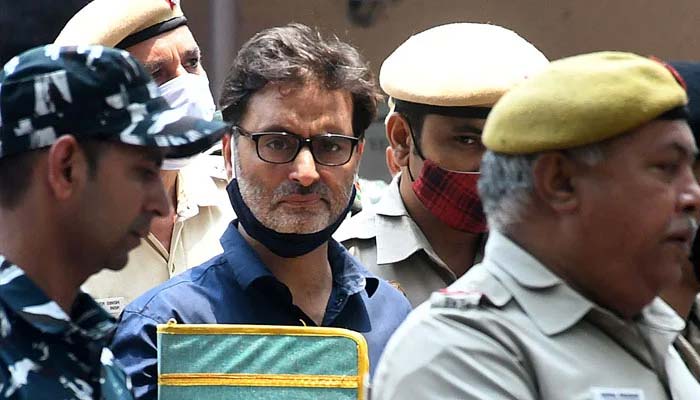
This is a prisoner's sworn affidavit, in which he asks a court for death in order to send a message of freedom to his people. Spanning 25 pages, this document, on one hand, narrates the tragedy of injustices carried out in the courts of the world's biggest democracy, and on the other hand brings forward the prisoner's own tragedy — which is, in truth, the tragedy of his entire nation.
The prisoner who wrote this affidavit appears at times as a lawyer, at times as a revolutionary like Nelson Mandela, at times as a son worried about his elderly mother, at times as a helpless husband thinking about his wife's future, and at times as a father who has not seen his only daughter in eight years.
In the affidavit submitted on August 24, 2026, to a court in Srinagar by Yasin Malik — leader of the Jammu and Kashmir Liberation Front, imprisoned in India's Tihar Jail — the revelations have put Prime Minister Narendra Modi and his National Security Adviser Ajit Kumar Doval in history's dock as accused men. The facts stated by one prisoner have exposed the two hypocrites and left them without an answer.
Malik is being tried in a Srinagar court over the murder of a Hindu nurse, Sarla Bhat, who was kidnapped and killed 36 years ago. Sarla Bhat was killed on April 19, 1990, while Yasin Malik says that he had been severely wounded during a raid by the Indian Border Security Force (BSF) on April 8, 1990, when he jumped from the fifth floor of a building. BSF personnel never recognised him and thought him dead.
They shifted him to a hospital, and on April 26, 1990, Indian state television channel Doordarshan had already broadcast news of his death and secret burial by JKLF. When Sarla Bhat was murdered, Yasin Malik was lying on a hospital bed, and he was in a coma for many days. Denying the charge of murdering Sarla Bhat, Yasin Malik says he only learned of the nurse's murder much later, in 1991, through an investigating officer.
In his affidavit, Yasin Malik states that sometime after Sarla Bhat's murder, he was arrested inside the hospital in August 1990. He was airlifted from Srinagar to Tihar Jail in Delhi on August 8th 1990. In November 1990, then–Indian prime minister Chandra Shekhar expressed a wish to meet him and invited him to dinner. Yasin Malik told those who brought the prime minister's invitation that it would not be appropriate for a prisoner to dine with the prime minister.
Following this refusal, he was punitively transferred from Delhi to Agra jail. He writes that during his imprisonment, various Indian prime ministers kept contacting him, seeking his help in playing a role in Pakistan-India peace talks. R.K Mishra and Brajesh Mishra met him many times when they were quietly talking to then Pakistani foreign secretary Niaz A Naik, who was working for prime minister Nawaz Sharif.
In 2000, IB Director Ajit Kumar Doval and Prime Minister Atal Bihari Vajpayee's National Security Adviser Brajesh Mishra met him many times in Delhi. At that time, Yasin Malik was seriously ill in prison. Arrangements were made to send him to the United States for treatment, and the Indian government also issued him a passport. When he arrived in America for treatment at Johns Hopkins Hospital, R.K Mishra, besides conveying Vajpayee's good wishes, sent him $50,000 for his treatment — but Yasin Malik refused to accept the money. Separately, Pakistan's ambassador to the US, Dr Maleeha Lodhi, sent him $30,000 through Altaf Qadri, but Yasin Malik declined to accept that sum as well.
In his affidavit, Yasin Malik writes that Narendra Modi, for political advantage in the 2019 and 2024 elections, made extensive use of a photograph about one of his meetings with former Indian prime minister Manmohan Singh, propagandising that Congress leader Manmohan Singh had been meeting Yasin Malik, "the killer of Hindu pandits" — yet no mention is ever made of the meetings that Ajit Doval, today Modi's National Security Adviser, himself had with him in jail.
Reading Yasin Malik's affidavit, I was reminded of the meetings he had with me in Islamabad in 2005 and 2006. In that period, Indian prime minister Manmohan Singh and Pakistan's president General Pervez Musharraf were seeking help from Kashmiri leaders — Omar Abdullah, Mehbooba Mufti, Mirwaiz Umar Farooq, Yasin Malik, and a few others — to make peace between India and Pakistan by resolving the Kashmir dispute. Whenever Yasin Malik got permission to visit Pakistan, he would always meet me. On one occasion, in the presence of his associate Rafiq Dar, he even sought my advice about marrying Mushaal Malik, whom he met in Islamabad. From our conversations, I got the impression that he did not agree with General Musharraf's Kashmir policy, but was in favour of pushing the talks between the two countries forward. At one point he told me: "Omar Abdullah (current Chief Minister of Indian Illegally Occupied Jammu & Kashmir) is in Pakistan — call him onto your show, Capital Talk, on Geo TV, and call me there too, then watch what I do."
I also wanted to find out where the two of them really stood on those days. I invited Omar Abdullah onto my show and, as a surprise, seated Yasin Malik beside him. On that show, Yasin Malik exposed Omar Abdullah's hypocrisy. After the show, Omar Abdullah was angry with me on one side, and General Pervez Musharraf was angry on the other. Musharraf was trying to unite important Kashmiri leaders behind his Kashmir policy, which aimed to declare the LoC as a permanent border.
Musharraf believed that Syed Ali Geelani was behind this conspiracy to pit Omar Abdullah and Yasin Malik against each other. Musharraf deeply disliked this elderly Kashmiri leader because Geelani had once told him not to carry out a military operation in Balochistan, which had angered Musharraf greatly. Syed Ali Geelani once told me in Delhi before the Agra talks in July 2001 that “don’t trust Musharraf, he knows nothing about Kashmir”.
Musharraf was aware of my contacts with Syed Ali Geelani — though in fact I had had no conversation with Geelani about that show; the idea for it had come from Yasin Malik himself.
In his affidavit, Yasin Malik has exposed the double standards of India's rulers, but he makes no mention of his own meetings with Pakistan's rulers, nor of his disagreement with Musharraf and other Pakistani leaders. Today, some officials in Pakistan level the same kind of allegations against his party, the JKLF, that the Indian government levels against it. The affidavit submitted by Yasin Malik in a Srinagar court is in fact a slap in the face of all those in Pakistan who allege that JKLF is working as an Indian proxy in AJK.
Toward the end of his affidavit, Yasin Malik says “I have decided not to contest the court proceedings further. My decision shall not be treated as an admission of the allegation made against me”. He writes that he denies killing Sarla Bhat — but goes on to tell the court: “I request for Capital Punishment."
By withdrawing his own defence, he has made the court's task easy, since, he says, this court was established for the very purpose of hanging him. Finally, with great respect and love, he releases his beloved wife Mushaal Malik from their marriage, asking her to begin a new life, since she still has so much of her life ahead. He instructs his dearest daughter, Razia Sultana, to call her grandmother in Srinagar every day, so that she does not feel alone during this difficult time.
This affidavit is the voice of a revolutionary freedom fighter's conscience — his final testament. It is not merely an affidavit; it is a charge sheet against Indian democracy and the ruling party that is trying to fan hatred between Kashmiri Hindu Pundits and Kashmiri Muslims. Yasin Malik narrated many facts in his affidavit and tried to explain how the bad policies of the Indian government created problems for the Hindu Pundits in Kashmir. He exposed the hypocrisy of many Indian journalists and film actors, including Shatrughan Sinha, who once invited him on his TV show but edited many things. The tragedy set out in this affidavit cries out to the whole world that Yasin Malik could neither be bought nor bent. With great dignity and courage, he is asking for the noose — because that very execution will become the death of his killers.
The writer is a senior journalist, anchor, and columnist, associated with Geo News. He posts on X@HamidMirPAK