First images of SpaceX rocket's lunar crash site released: See aftermat
NASA, SpaceX track Falcon 9 stage after it crashes into Moon at 5,400 MPH
Published August 08, 2026
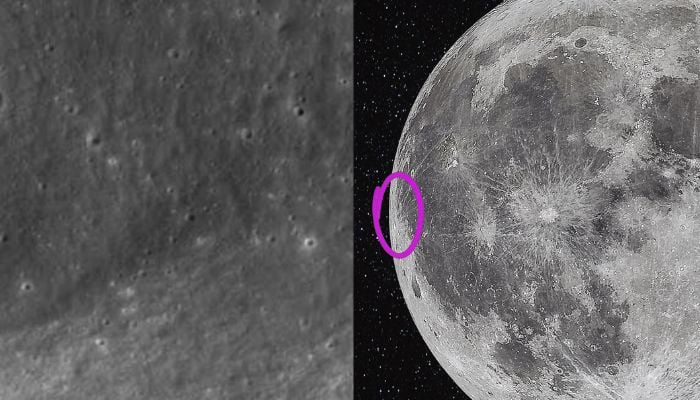
A South Korean lunar orbiter has captured the first images of the fresh crater left on the Moon’s surface following a stray SpaceX Falcon 9 rocket stage crashing into it earlier this week.
Pictures of the area struck by the rocket were provided by the Korea Aerospace Research Institute (KARI), which has the Danuri spacecraft that flew over the area almost immediately after the collision on Wednesday, Aug. 5. The pictures depict a darker area due to the crater created during the impact and the rocks scattered in the surrounding area.
The fragment of the rocket, a Falcon 9 upper stage that was launched in January 2025, hit the moon at about 5,400 mph (8,700 kph) near the Einstein and Bell craters. This stage has successfully deployed the Blue Ghost 1 lunar lander made by Firefly Aerospace under a commercial NASA lunar payload program but remained in an unstable orbit. After several months, due to solar activity and the gravity of the Earth, the Moon, and the Sun, its trajectory changed, causing the stage to collide with the surface of the Moon.
SpaceX confirmed the accidental impact, stating that controlled deorbiting is not always possible for high-energy missions heading to lunar transfer orbits. The company noted that it is working to ensure space safety even on complex missions.
As noted by NASA, its Lunar Reconnaissance Orbiter will get new images of the impact site next week. The possibility of this crash has been proven before thanks to the use of the data gathered by the Centre for Near Earth Object Studies of NASA, and the chance of the collision was 100 per cent.
Impacts made by humans on the Moon do not happen often, although meteoroids of similar energy strike the lunar surface once every six days. It should be stressed that monitoring such impacts can give a lot of information about the geology of the Moon.
There is no danger for our planet in this situation, and NASA keeps in contact with SpaceX about it.