Built for sunny days
What should be relief from the summer heat has become an annual urban disaster
Published July 31, 2026
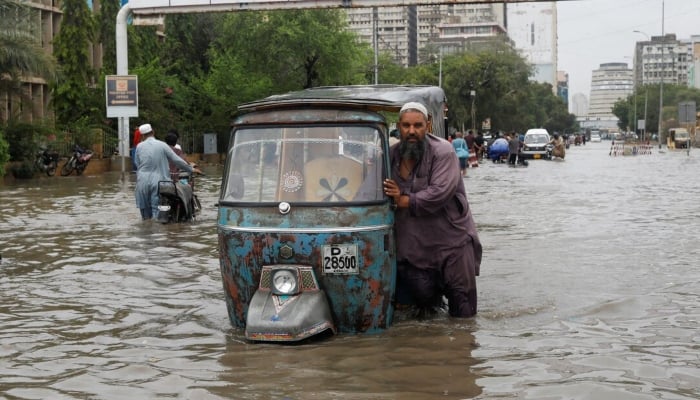
For most of the world, rain is a blessing. But in Sindh's cities – Karachi, Hyderabad, Sukkur – a few hours of heavy rainfall can turn hope into hardship. Streets become rivers, homes are inundated, businesses grind to a halt, and ordinary lives are upended. What should be relief from the summer heat has become an annual urban disaster.
The numbers tell us this is no longer an occasional misfortune. In August 2020, Karachi received 484 millimetres of rain – the wettest August since records began in 1931, against a monthly average of barely 68 millimetres. On a single day, 27 August, the city recorded 223.5 millimetres in twelve hours, shattering a record that had stood since the 1960s. More than 40 people died.
Two years later, the 2022 super-floods killed some 1,739 people nationwide, affected 33 million and caused damages and economic losses exceeding 30 billion dollars – with Sindh bearing close to 70% of that toll. The World Bank estimated the direct hit at around 2.2% of national GDP.
Climate change is real and science is clear: extreme rainfall events across South Asia are becoming more frequent and more intense. But nature alone did not do this to us. Decades of unplanned urbanisation, encroachment upon natural waterways, weak enforcement of building regulations and chronic neglect of drainage infrastructure have manufactured our vulnerability. Karachi – a city that generates roughly a fifth of Pakistan's GDP and whose ports handle the overwhelming share of the country's trade – struggles with rainfall that many cities around the world manage routinely.
Behind every flooded street lies a human story: the street vendor who loses his only source of income; the daily-wage labourer stranded for hours who returns home empty-handed; the mother carrying a sick child through waist-deep water; the elderly citizen trapped without electricity or medicines. For residents of low-lying informal settlements, a single night can wash away furniture, documents, schoolbooks and food supplies – losses that households near the poverty line may take years to recover. Stagnant water then breeds mosquitoes and disease, while overflowing sewerage exposes entire communities to health hazards precisely when hospitals become hardest to reach.
None of this is inevitable. Having served as administrator and municipal officer in two district headquarters municipalities, I can say with confidence that the solutions are neither mysterious nor unaffordable. What has been missing is implementation.
The first priority is the complete removal of encroachments from natural waterways and stormwater drains. Successive governments have blamed their predecessors for decades; those excuses no longer carry credibility. Many of the principal drainage networks laid during the British period still reflect sound engineering; they need rehabilitation and capacity enhancement, not abandonment. Drainage must be redesigned for today's population, rainfall intensity, and climate projections, not the assumptions of half a century ago. Numerous feasibility studies and master plans already gather dust; the task now is to translate them into action.
Second, maintenance must become routine, not seasonal. Karachiites remember the devastating flooding of 2006 in Clifton and DHA. Storm-water systems installed afterwards worked well initially, but without desilting and repair, their efficiency declined. Desilting must never be cosmetic: entire channels, from outfall to upstream, must be cleared of silt, debris, and vegetation, and the removed material transported to disposal sites within 72 hours so it is not simply washed back in. It is telling – and difficult to justify – that every year our monsoon contingency plans identify exactly the same choking points. That recurring list is itself an indictment: permanent solutions have rarely been pursued.
Third, pumping infrastructure designed decades ago must be reviewed and expanded for today's wastewater volumes, with reliable backup power. Wherever topography permits, gravity-based drainage should be preferred over pump-dependent systems – cheaper to run, and far more reliable when the power fails, as it invariably does during storms. And no road project or housing scheme should receive approval without a properly designed drainage component.
Fourth, solid waste. Karachi generates an estimated 12,000 to 16,000 tons of municipal waste every day, and only a fraction is properly collected and disposed of. Much of the rest ends up in drains, empty plots, and ultimately the sea. Every ton dumped into a nullah is a flood waiting for the next downpour. Daily collection, proper disposal, and substantial penalties for dumping into drains are non-negotiable.
Finally, governance. In Karachi alone, responsibility is fragmented across KMC, town municipal corporations, KW&SC, SSWMB, development authorities, cantonment boards, KPT, PDMA and more. Overlapping mandates produce fragmented decisions and, conveniently, no accountability. A robust coordination mechanism must define who does what before, during and after the monsoon – and hold each agency answerable for it, all year round.
Urban flooding is not merely an engineering problem. It is a governance failure, an economic drain, and above all a humanitarian issue. The knowledge and technical expertise already exist; what has been lacking is sustained political commitment. The 2022 floods alone cost Pakistan more than thirty times what serious preventive investment in urban drainage would require. Prevention will always be cheaper than disaster.
The resilience of Sindh's people is remarkable, but resilience must never become an excuse for recurring crises. The true measure of urban development is not how a city functions on sunny days, but how well it protects its people when the storms arrive.
The writer is a former regional director of local government in the government of Sindh.
Disclaimer: The viewpoints expressed in this piece are the writer's own and don't necessarily reflect Geo.tv's editorial policy.
Originally published in The News