India's hydro war on Pakistan (Part – I)
This is no longer a legal dispute. It is a state in open defiance of binding international adjudication
Published July 09, 2026
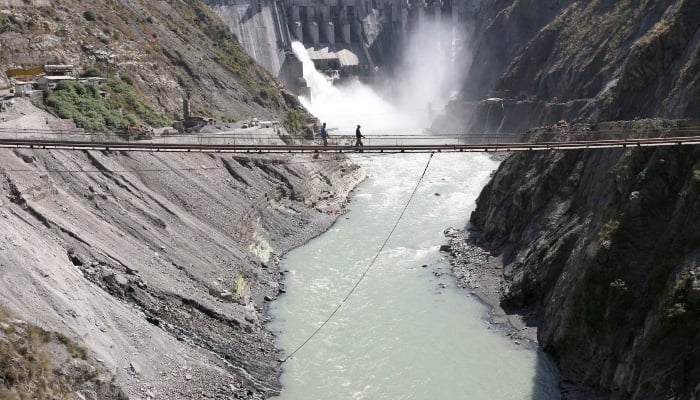
A war is unfolding on Pakistan's rivers. It is waged through dams, diversions, withheld data and unilateral declarations, through the steady dismantling of a legal framework that two states spent 65 years honouring.
The Indus Waters Treaty of 1960, brokered by the World Bank, is one of the most technically precise transboundary water agreements ever concluded. It cleanly divided the six rivers of the Indus Basin: the three eastern rivers, Ravi, Beas and Sutlej, to India; the three western rivers, Indus, Jhelum and Chenab, to Pakistan. Article III leaves no room for ambiguity. India is obligated to let all the waters of the western rivers flow and may not interfere with them. That obligation was held through three wars and every diplomatic rupture the Subcontinent has seen. In April 2025, India declared it wants out.
The Pahalgam attack was the fig leaf. Before Indian investigators had identified a single attacker or produced any evidence linking Pakistan to the incident, India declared the treaty 'in abeyance'. That phrase carries no weight in international law. Article XII(4) states plainly that the treaty continues in force until terminated by a duly ratified agreement concluded for that purpose. There is no exit clause and no mechanism for abeyance. UN special rapporteurs have said as much, calling it irrelevant to the treaty's continued operation and to Pakistan's rights under it. Their report went further, stating plainly that the treaty is strictly bilateral and that no single party has the authority to suspend or terminate it on its own. On India's attempt to link the abeyance decision to unproven terrorism allegations, the experts found the argument legally unsustainable, noting that India failed to produce credible evidence to support it.
The Permanent Court of Arbitration in The Hague has confirmed this three times. A Supplemental Award in June 2025 rejected India's argument that extraordinary circumstances could justify suspension. A Final Award in August 2025 directed India to ensure the uninterrupted flow of the western rivers and set precise technical limits on its hydropower designs, including on the Kishanganga and Ratle projects. A further ruling in May 2026 found that India's expanded storage projections exceed treaty limits and cannot be justified through inflated capacity assumptions.
Four points are now settled: India's non-appearance does not paralyse proceedings; the abeyance posture does not deprive the court of jurisdiction; the awards are final and binding; and India must let the western rivers flow, with treaty exceptions applied strictly. India has rejected every ruling and boycotted the proceedings entirely. This is no longer a legal dispute. It is a state in open defiance of binding international adjudication.
Pakistan brought this case to the court in 2016, seeking a general interpretation of the treaty's provisions governing Indian development on the western rivers, specifically the Kishanganga and Ratle hydropower plants. The court's reasoning treats the treaty as resting on three linked bargains: a peace bargain converting post-Partition fears of upstream coercion into binding law, a division bargain allocating the six rivers between the two states, and a hydropower bargain permitting India to build run-of-river plants only within tightly drawn limits.
The court went further, holding that the treaty carries an object and purpose akin to a boundary treaty, stabilising rights over a shared resource in a way ordinary agreements do not. The same award clarified how narrow India's permitted exceptions are: low-level outlets are barred unless strictly necessary and must sit as high as possible, gated spillways are to be avoided wherever site conditions allow, and turbine intakes and pondage limits are capped well below what unconstrained engineering practice would recommend. None of this is discretionary.
While international courts aver unambiguously, India builds. The evidence is material. Seventeen Indian projects on the Indus system have now been identified as tools of hydro-hegemony. A single project may have prompted technical responses. A cluster of accelerated works advancing without data, without inspection and without any engagement through the commission is a huge, cumulative strategic intervention. On the fly, India is fast-tracking at least four other major projects on the upper Chenab alongside Sawalkote, including Pakal Dul, Kiru, Kwar and Ratle, using international consultants at pace.
Tenders for the 1,856MW Sawalkote project went out within weeks of the abeyance declaration. Dulhasti Stage-II was approved unilaterally in January 2026 without notifying Pakistan, in direct breach of the treaty's consultation requirements. The Baglihar dam gates were shut through the critical Kharif sowing season of 2025, cutting Chenab flows without warning. The Salal reservoir was flushed ahead of schedule and without notice, sending sudden surges downstream, and India is now planning further silt-flushing that would give it a degree of flow control that the treaty and the 1978 Salal Agreement both prohibit. That 1978 agreement required Salal's outlet works to stay permanently sealed with concrete plugs, reopened only in a genuine safety emergency and only after immediate notice and joint inspection, conditions India has not met. India has also reopened low-level outlets at the Marala Barrage, enabling reservoir cycles that control downstream flows at will.
The data blackout deepens every other violation. Pakistan has written to its Indian counterpart four times since April 2025 over unexplained fluctuations in the Chenab's flow and has received no reply. The pattern is now well documented. In May 2025, Marala recorded a spike to 78,276 cusecs, followed by a crash to 1,527 cusecs, with no rainfall to explain either. In December 2025, flow at the same barrage fell to 870 cusecs without warning, and by May 2026 levels at Marala had fallen from 21,887 to 5,689 cusecs inside a single event window.
Requests for meetings, inspections, project information and consultations under Article IX have gone unanswered. Monthly flow data has not been shared since August 2023. The last meeting of the Permanent Indus Commission was held in May 2022. Article IX built a graduated process precisely to prevent this kind of paralysis: institutional resolution first, third-party determination where needed, but never a vacuum. India has switched off every layer of that process at once.
When an upstream state stops sharing data, the downstream state can no longer tell whether it is facing nature or a deliberate operation. That distinction is not a technicality. It is what keeps a hydrological dispute from becoming a security crisis, and India's lack of transparency is steadily leading to conflict.
Indian rhetoric aimed at provoking Pakistan may have unintended consequences. Indian Home Minister Amit Shah publicly announced an 113km canal to divert Chenab flows toward Jammu, Punjab, and eventually Rajasthan within three years, and said outright that India will never restore the treaty. India's water minister has gone further still, stating publicly that not a single drop will reach Pakistan in the years ahead. But here's the rub: by tying the treaty's suspension explicitly to an unresolved conflict, and by having ministers state openly that the goal is to deny Pakistan water altogether, India has itself supplied the evidence that would strip these projects of the protection they would otherwise enjoy under the law of armed conflict. Dams and similar installations ordinarily receive specific protection under international humanitarian law during armed conflict, but that protection lapses when a structure is used in direct support of a military objective against the other party. This is not a conclusion Pakistan needs to construct. It follows from India's own public statements.
The Indus Waters Treaty was never a concession from one side to the other. It was a settlement negotiated in the shadow of partition, because the rivers running through Punjab and Sindh could not be left to chance or to anger. Pakistan built its irrigation economy and its national water planning on the understanding that the western rivers would keep flowing, and that understanding still holds, regardless of what India now chooses to call it.
What India is doing, defying binding arbitration, withholding data, building towards diversion, is not simply pressure on Pakistan. It is a test of whether India's claim to democratic, rules-based conduct means anything when a treaty becomes inconvenient. New Delhi has already lost more reputational capital than it has gained since May 2025, and its latest tenders on the Chenab suggest it has yet to reckon with that cost. Pakistan does not intend to let it profit from its hydroterrorism.
To be continued
The writer is chair of the Senate Climate Standing Committee and former climate minister of Pakistan.
Disclaimer: The viewpoints expressed in this piece are the writer's own and don't necessarily reflect Geo.tv's editorial policy.