'Unilateral interference' with IWT has 'profound' implications, warns DPM Dar
DPM says water security for Pakistan inseparable from economic, food, national security
Published August 28, 2026
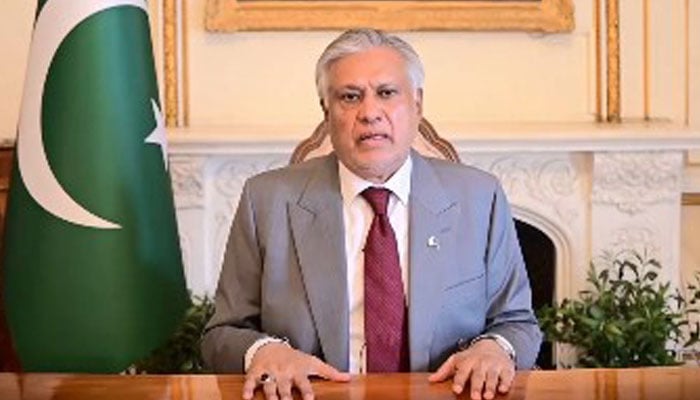
- DPM Dar says IWT has no suspension provision.
- DPM calls IWT an instrument of regional stability.
- Says IWT endured wars, diplomatic breakdowns.
Deputy Prime Minister and Foreign Minister Ishaq Dar on Friday warned that the implications of “unilateral interference” with the Indus Waters Treaty are “consequently profound”.
The DPM made the remarks while delivering a keynote address at a seminar titled “The Indus Waters Treaty: South Asian Security at the Crossroads”, organised by the Embassy of Pakistan in Washington.
The Indus Basin is the lifeline of more than 250 million Pakistanis, he said, adding that their agriculture, food security, energy production, livelihoods and economic development are deeply dependent upon the waters of the Indus River system.
The DPM said that water security for Pakistan is therefore inseparable from economic security, food security and, ultimately, national security.
“The implications of unilateral interference with such an arrangement are consequently profound,” he warned.
The DPM said: “They affect not only the stability of South Asia but create a dangerous precedent for treaty relations everywhere.”
Pakistan’s position is clear and consistent: the Indus Waters Treaty remains valid, binding and fully operative despite India’s assertion of “abeyance”, Dar added.
The DPM said that India’s unilateral decision in April 2025 to place the treaty “in abeyance” had no basis in the agreement, which he said contained no provision allowing either side to unilaterally suspend it.
“Nor can either party, through a unilateral political declaration, extinguish obligations solemnly undertaken under international law,” he said.
He said treaty-based proceedings had continued despite India’s assertion of “abeyance”, reinforcing the principle that unilateral action could not displace an agreed legal framework.
The DPM said the IWT is “not merely an agreement about water” but a legal framework governing a vital shared resource and an instrument of regional stability.
He recalled that Pakistan and India concluded the treaty in 1960 after years of negotiations facilitated by the World Bank.
Under the agreement, the three Eastern Rivers — Ravi, Beas and Sutlej — were allocated to India for unrestricted use, while the three Western Rivers — Indus, Jhelum and Chenab — were allocated to Pakistan for unrestricted use, subject to the specific and carefully defined uses permitted to India under the treaty.
Dar said the treaty established the Permanent Indus Commission and mechanisms for addressing questions, differences and disputes, including through a neutral expert and, where required, a Court of Arbitration.
“That institutional architecture was not incidental to the treaty. It was central to the bargain,” he said.
The treaty had endured wars, military crises, diplomatic breakdowns and prolonged periods of political tension between the two countries, Dar said.
“Its resilience demonstrated a simple but powerful principle: even the most difficult relationships can sustain cooperation when agreed rules are respected,” he said.
The DPM said the issue extended beyond Pakistan and India, involving “the sanctity of treaties” and confidence in international law.