'Let us wail!' Iranians flock to Khamenei's funeral after wartime death
Millions expected to attend events across Tehran this week
Published July 04, 2026
- Iran stages mass funeral processions for Khamenei.
- Khamenei ruled Iran from 1989 until his death at age 86.
- Crowds chant slogans against the United States.
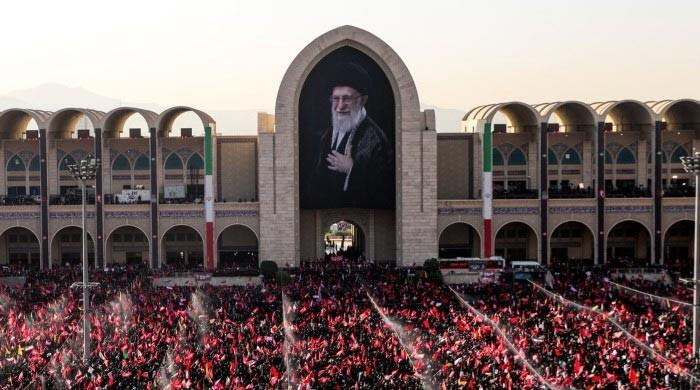
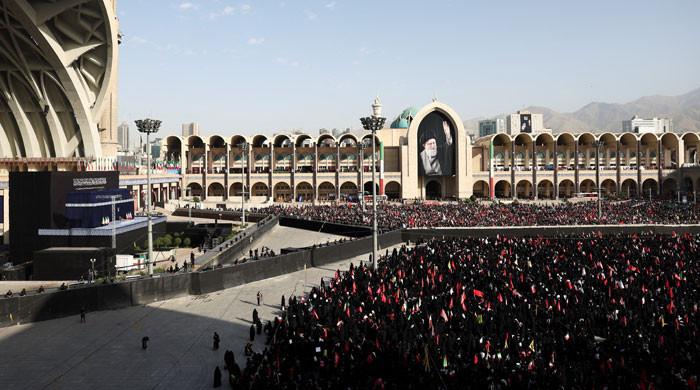
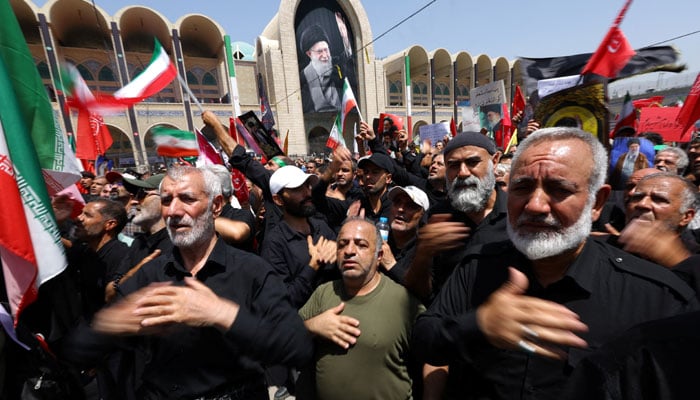
Tens of thousands of Iranians thronged a vast outdoor prayer complex in Tehran on Saturday to view the coffin of Ayatollah Ali Khamenei, who ruled the Islamic Republic for 37 years before being martyred at the start of the US-Israeli war on Iran.
Dressed in black and draped in the red, white and green flags of the Islamic Republic of Iran, mourners held up posters and A4 printed sheets with pictures of Khamenei and his son and successor as supreme leader, Mojtaba Khamenei.
Iran is staging mass funeral processions for Khamenei, who was martyred in February by the opening airstrikes of the war launched by the US and Israel, in a show of public devotion to the Islamic Republic's theocratic state and revolutionary zeal.
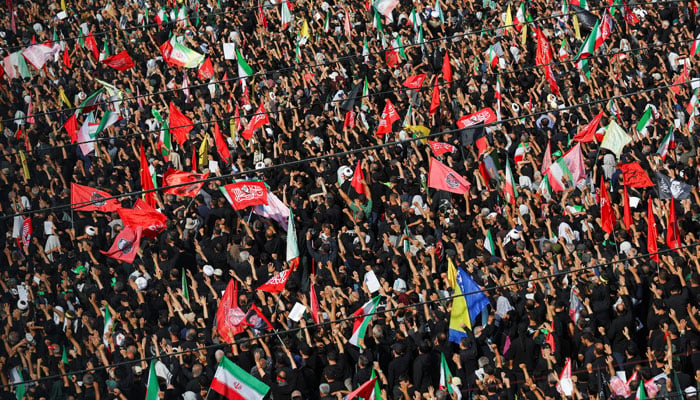
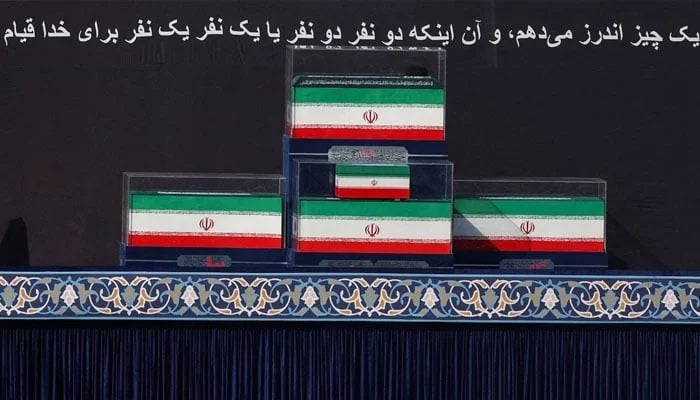
After a day of Khamenei lying in state indoors for senior Iranian leaders and foreign officials to visit, his coffin, and those of several family members killed in the same airstrike, were brought to an outdoor stage for the general public to view from a distance, television footage showed.
Mourners filed into the vast courtyard of the Imam Khomeini Grand Mosalla, beating their chests, wailing and waving the banners of the Islamic Republic and historic Muslim martyrs. Women dressed in black chadors wore white visors or held umbrellas to shield from the hot mid-morning sun.
"Let us wail!" a compere encouraged the crowds through a loudspeaker. "Everybody chant oppressed, everyone say Hussein," he said, invoking traditions of sacrifice, including that of the Prophet Mohammad's (PBUH) grandson Imam Hussein (RA). On cue, the crowds wailed and chanted.
The Israeli strike that martyred Khamenei also martyred his daughter, grandchild, daughter-in-law and son-in-law, according to Iranian state media.
Their five coffins, all draped in Iranian flags and placed on a raised platform, included a tiny one for the 14-month-old granddaughter.
Iran's military and security institutions vowed revenge for Khamenei's death, and chants of "Death to America" echoed through the Mosalla, state broadcaster Seda va Sima said.
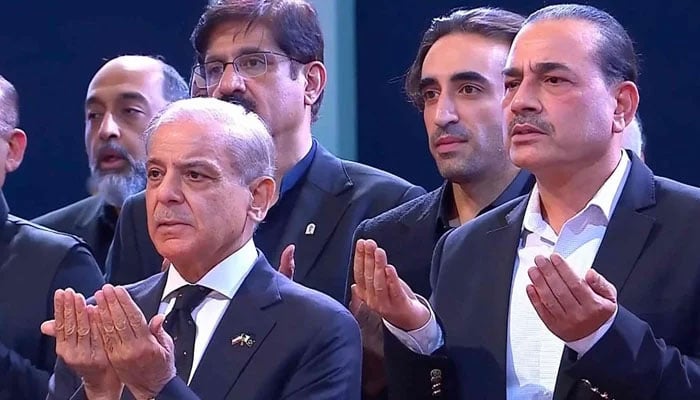
International guests paying respects Friday included Prime Minister Shehbaz Sharif, whose country has been mediating between Iran and the US, and Russian ex-president Dmitry Medvedev, now deputy head of the Russian security council, who attended on behalf of President Vladimir Putin.
Destructive wars and no peace
The funeral is taking place at a critical moment for Iran, where the clerical rulers backed by the Islamic Revolutionary Guard Corps (IRGC) are buoyed from surviving what they saw as an existential war against their most powerful foes.
Mojtaba Khamenei, who has long been close to Iran's elite IRGC, has not been seen in any new image since being wounded in the strike that martyred his father.
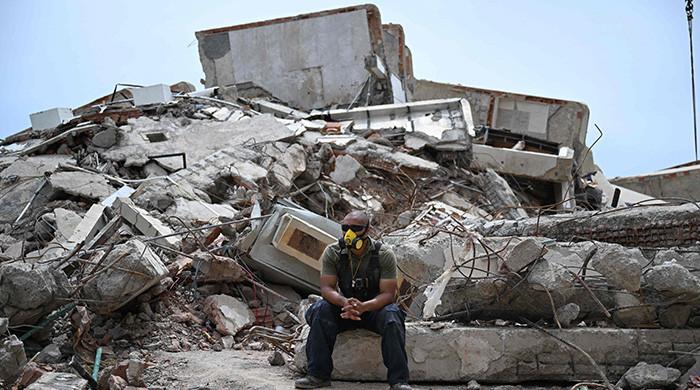
Thousands of US and Israeli airstrikes hit a range of military targets, energy and civilian infrastructure during weeks of war. The attacks killed more than 3,000 people in Iran, according to state media.
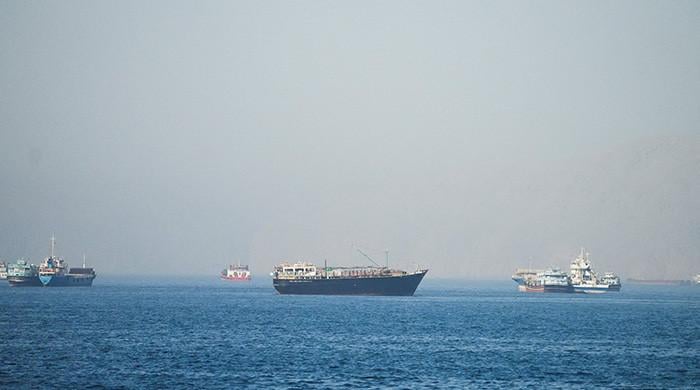
Iran retaliated with strikes on US bases, missiles fired towards Israel and a series of hits on energy targets in Gulf Arab states, while choking oil shipping through the Strait of Hormuz. At least 13 US troops have been killed.
Thousands more people have been killed across the region in the fallout from the war, notably in Lebanon where Israel continues to fight the Iranian-backed Hezbollah group. Israeli attacks and demolitions have flattened vast swathes of civilian areas in southern Lebanon.
The US and Iran reached a shaky ceasefire by early April, and signed an initial agreement to halt fighting in June, although some tit-for-tat attacks continue.
The US-Iran rivalry has helped keep the Middle East in a state of conflict, along with Israel's own wars against Iranian allies and its campaigns against Palestinians.
Observers say the war, which killed many senior Iranian military and security officials, has empowered hardline leaders in the country who are more willing than the late Khamenei was to launch direct attacks against their adversaries.
Martyrdom
In Iran's theocratic system, Khamenei was head of state and leader of a revolutionary movement.
His death in an enemy attack plays into a powerful tradition of martyrdom and mourning.
Khamenei's coffin was unveiled late on Thursday. On Friday, the coffin was laid in state in the great prayer hall built to honour his predecessor, Ayatollah Ruhollah Khomeini.
The coffin will remain in the Mosalla until Sunday evening.
Burials are meant to be conducted within a day of death in Islam, but because of the risks of holding a big funeral during the war it was postponed until after last month's interim truce deal was agreed.
After what authorities are billing as a massive procession in central Tehran on Monday, the remains will be taken to the seminary city of Qom, for ceremonies on Tuesday.
Ceremonies will then be held in Iraq's shrine cities of Najaf and Karbala on Wednesday, with prominent attendees from Iran's regional network.
He will be buried on Thursday, after another procession, in Mashhad near the tomb of the Imam Reza, a figure of great devotion in Iran.
Authorities plan to mobilise millions of people for big processions over the coming days, offering transport, food and lodging to buoy the numbers and encourage more of Iran's population of over 90 million to attend commemorations.